
'The trigger for the flood was definitely natural, but the damage that it caused was human-made.'

Rescue teams led by the Nepal army continue search operations to locate survivors from the August 26 disaster. 4,873 people remain missing.

'This is no longer a single-hazard problem; it is a cascading, multi-hazard problem. A landslide never occurs in isolation. This entire chain is the cascading effect of what looks, at first, like a single disaster.'

Usha Vedasalam completed the Kailash Mansarovar Yatra just a week before the devastating floods in Nepal. This is her account of the pilgrimage.

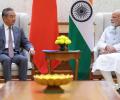
India and China have agreed to advance discussions on an "Early and Substantial Harvest" of boundary delimitation and border management during the 25th round of Special Representatives talks between National Security Advisor Ajit Doval and Chinese Foreign Minister Wang Yi in Beijing. Both sides reached an eight-point consensus, committing to the 2005 Agreement on Political Parameters and Guiding Principles for Settlement. Key outcomes include enhancing border management, improving understanding of the Line of Actual Control, establishing new meeting points and hotlines, and continuing cooperation on trans-border rivers and pilgrimage.
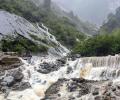
Flooding in Jummagad river flowing near Jumma village on the Joshimath-Niti highway, about 45 km from Joshimath, continued till late night on Monday evening, during which the bridge collapsed.
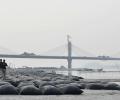
China has formally started the construction of a USD 167.8 billion dam over the Brahmaputra River in Tibet, close to the Indian border in Arunachal Pradesh, raising concerns in India and Bangladesh.
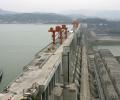
China has approved the construction of the world's largest dam on the Brahmaputra River in Tibet, close to the Indian border. The USD 137 billion project, which is expected to dwarf even China's own Three Gorges Dam, has raised concerns in India and Bangladesh, the downstream riparian states. Concerns in India are centered around China's potential to control water flow, potentially enabling the release of large amounts of water to flood border areas in times of hostilities. The dam is part of China's 14th Five-Year Plan, and the Chinese government claims that the project is safe and prioritizes ecological protection.
China defends its construction of a dam on the Brahmaputra river in Tibet, addressing concerns from India and Bangladesh about its potential impact on water flow and the environment.
China has defended its plan to build the world's largest dam on the Brahmaputra River in Tibet, assuring that the project will not affect riparian states and safety issues have been addressed through decades of studies. The dam, estimated to cost USD 137 billion, has raised concerns in India and Bangladesh, but Chinese authorities maintain that the project has been thoroughly studied and safeguards are in place. The dam is part of China's efforts to develop clean energy and respond to climate change.
Arunachal Pradesh Chief Minister Pema Khandu has expressed grave concerns over China's mega dam project near the Arunachal border, calling it a 'water bomb' and an existential threat.
'New Delhi is not naive about its foreign policy choices.'
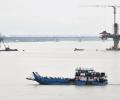
'China could intentionally release excess water.' 'The North East is already flood-prone during the monsoon, and even a controlled release from Chinese dams (during the monsoon) could worsen flooding.'

'China has thus far been cautious, emphasising its focus on development rather than weaponising water resources.'

In the talks, China emphasised that the two sides should proceed from the fundamental interests of China, India and adhere to the strategic height and long-term perspective of China-India relations, the readout said.
China also said it will continue to share the flood data with India.
India on Saturday announced a relief assistance of NRs 48 million for the victims of recent floods and landslide in different parts of Nepal, which has claimed nearly 220 lives in two weeks.

Since Tibet's occupation, China has disrupted the natural flow of rivers by pursuing a series of ill-conceived environmental and developmental policies such as the Great Leap Forward, the South-North Water Diversion Project, etc, the report said, adding that, this has led to a dam-building spree on the Tibetan plateau with disastrous impacts on Asia's major rivers.

China's parliament on Thursday adopted the 14th Five-Year Plan, the mega blueprint containing billions of dollars worth of projects, including the controversial hydropower project on the Brahmaputra river in Tibet close to the Arunachal Pradesh border over which India has raised concerns.
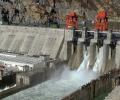
The over 3,800-km-long Brahmaputra, one of the longest rivers in the world passes through China, India and Bangladesh and has several tributaries and sub-tributaries.
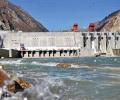
"The reservoir capacity of the project is less than 0.02 per cent of the average annual runoff of the Yarlung Zangbo-Brahmaputra. It cannot have an adverse impact on the downstream," Chinese foreign ministry said to a question on concerns over the dam.
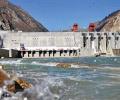
The government on Wednesday said any attempt by China to set up a hydropower station on the Brahmaputra river will act as an encroachment on the entitled rights of lower riparian states like India and Bangladesh and adversely affect the availability of water in its basin during the lean season.
The mighty Brahmaputra, one of the longest rivers in the world passes through China, India and Bangladesh and has several tributaries and sub-tributaries.

Rejecting criticism of tardy relief operations in flood-ravaged Uttarakhand, Union Finance Minister P Chidambaram has said government was making all efforts and complimented armed forces personnel for their untiring efforts in rescuing the stranded people.
However, Beijing expresses readiness for talks to reopen the Nathu La pass for the Kailash-Mansarovar Yatra.

The Centre on Tuesday told the Supreme Court that China has made a huge build-up in the Tibet region and the Army needs broader roads to move heavy vehicles up to the India-China border to avoid a 1962 war-like situation.
'India is planning to construct a multipurpose reservoir.' 'It will be a 10,000 MW hydropower project to offset the impact of the hydropower project by China.'

'India in 2020 is a lot better prepared than in 1962.' 'It is no longer a pushover; and anything other than a crushing Chinese military victory will be a major loss of face for China,' observes Rajeev Srinivasan in the first of a three part column.

China on Monday opened the second land crossing in Tibet via Nathu La to allow the first batch of Indian pilgrims undertaking the arduous Kailash-Manasarovar Yatra, in the latest confidence-building measure between the two neighbours.

'If one puts the context of what Xi Jinping said at the UN about not wanting a 'hot or cold war with any country', one realises that his speech was quite bizarre.' 'The world does not expect such statements from China, a nation aspiring to be a superpower.

The Standing Committee on Water Resources has recommended renegotiating the Indus Water Treaty with Pakistan to address the impact of climate change on water availability in the river basin and other challenges which are not covered under the agreement.

'The fatal mistake for the USSR was the invasion of Afghanistan.' 'Quite possibly the fatal mistake for the Chinese empire is the assault on Ladakh,' observes Rajeev Srinivasan.
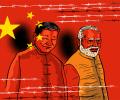
'As China rises and India grows to reclaim their earlier positions on the world stage as two of the largest economies and most important countries, there will indeed be some contention between these two powers.' 'There will also be plenty of space and room for cooperation amongst the two of us.' 'As our economic size increases to match the fact that we are the two most populous nations on earth, it will be all the more important for us to keep the interests of our peoples as well as those of the rest of the world in mind.' 'We shall have to grow together rather than as separate and disparate entities,' points out Ambassador Gautam Bambawale -- who served as India's ambassador to China -- in the 7th annual lecture of the Indian Association of Foreign Affairs Correspondents on March 1, 2019.

Here's a glimpse at what happened around the world last week

'Often reviled, mostly ignored, sometimes venerated, he has taken it all in his stride.' 'He has stood by the nation through thick and thin,' says Brigadier Gurmeet Kanwal (retd).

'I think the AAP is still in transition from being a movement to a political party so there is a mix of people who form the party. So there is somewhat of a overlapping and commonality of purpose.' 'Look at the way the government and party is functioning, not a single woman minister in the cabinet, or no woman member in the political affairs committee, it is all very tactical now.' 'After the 'sting' I decided to step back. I realised that my moral basis has been questioned by Kejriwal, it is truly despicable. He is around 15 years younger to me, I was aghast by his words.' AAP 'rebel' Prof Anand Kumar speaks of what went wrong with the party in the last few days in this interview with Upasna Pandey.
